Why Government Procurement Is Stuck in the Past



.avif)
Last updated: October 2026
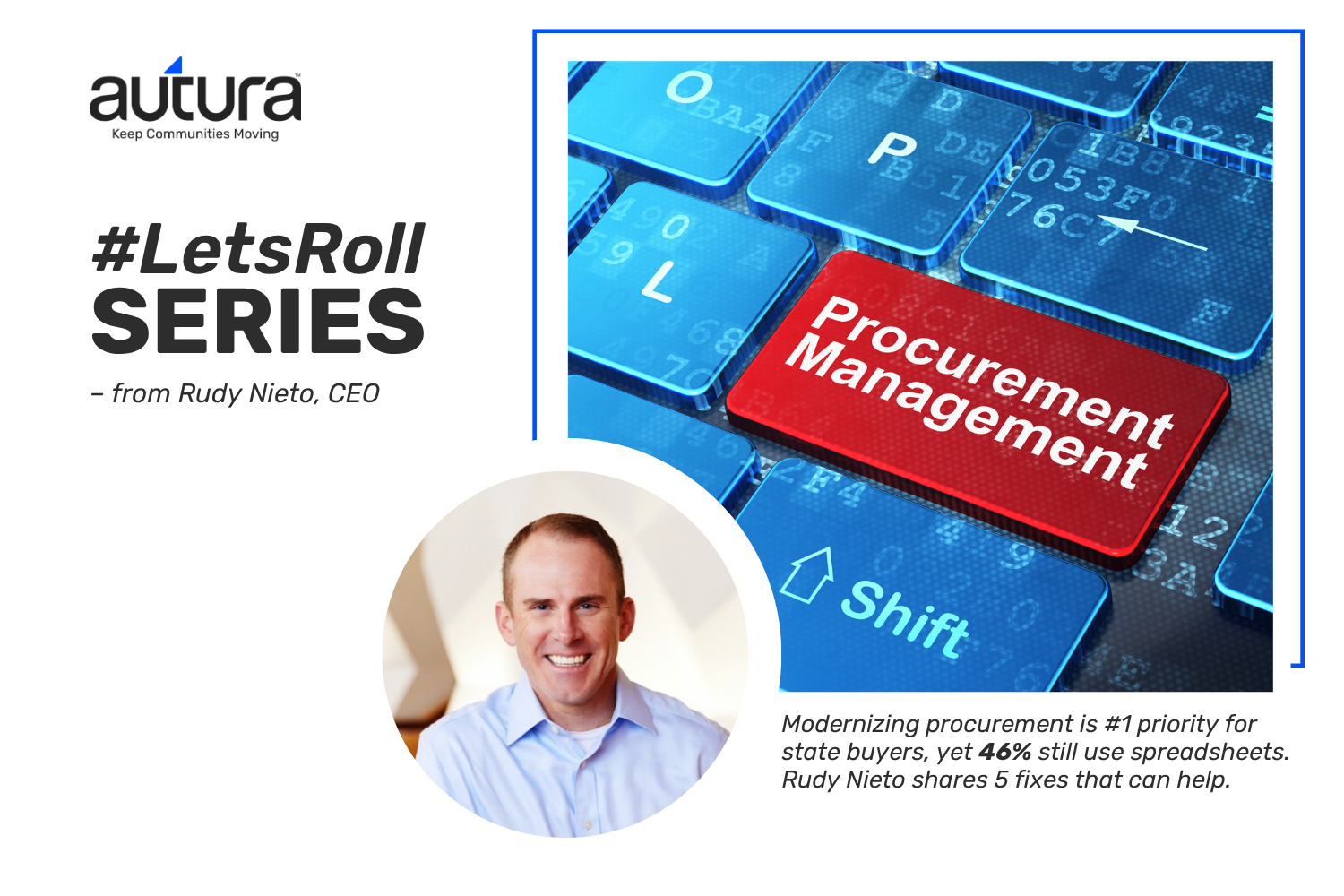
🔎In this article: State procurement leaders have called process modernization the top priority for two years running. Nearly half of public procurement teams still run on spreadsheets, email, or paper. Rudy shares his take on what keeps government buying stuck, what a good RFP looks like, what vendors owe agencies, and five changes that move the things faster.
I’ve spent most of my career on the vendor side of the table.
Over a decade at Reynolds and Reynolds, selling into enterprise dealer groups and OEM partners. Committees, scoring matrices, legal review, the works. Now I sit across from public safety agencies modernizing their towing programs.
Different industry. Same lesson. A slow buying process protects no one. It just delays the results you bought the solution to get.
Public safety is no exception. And the people running procurement know it.
For two years in a row Modernizing the Procurement Process ranks as the top priority shared by state chief procurement officers, according to NASPO's 2026 Top 10 Priorities for State Procurement. State CIOs are saying the same thing from their side of the table. In the 2026 NASCIO State CIO Survey, when CIOs were asked about what they would change, procurement came up. CIOs shared with survey conductors that existing procurement laws and processes remain a barrier to speed and modernization.
Now look at how the work actually gets done. Euna Solutions' 2026 State of Public Procurement Report found 46% of public procurement teams still run primarily on spreadsheets, email, or paper. NASCIO found only 10% of state CIO organizations use AI to automate any part of procurement.
That’s the gap. Everyone agrees it has to change. Almost nobody has the tools to change it.
This isn't a knock on procurement officers. The same Euna report found 42% of them are buried in urgent, unplanned requests, and 55% are working with flat or shrinking budgets. They're doing a hard job with old tools, under rules that were mostly written for buying things that don't change after delivery.
One NASCIO State CIO Survey respondant put it better than I can:
"…Legacy procurement and budgeting cycles are built for one-time capital projects rather than the iterative, continuous-delivery model that modern digital services require."
A snowplow is the same snowplow on day one and day one thousand. Software is not.
What government procurement delay looks like from a vendor's seat
I read a lot of RFPs. The ones that stall share the same traits:
- Last cycle's RFP with the dates changed. It describes the exact workflow the agency is trying to escape.
- Two hundred requirements, all weighted the same. “Exports to PDF” should never score the same as “gets officers off the side of the road faster.”
- A short response window for a problem the agency spent a year defining.
- No demo, no reference calls, no chance to see the software work before it’s scored.
- Price decides everything, and nobody prices what implementation and adoption actually cost.
None of these come from bad intent. They come from an old template, a tight deadline, and a team spread too thin.
5 changes to smooth government procurement
The good news: most of what makes procurement slow is process, not statute. Process can change. Here’s what the best buyers I’ve worked with do differently:
- Lead with the problem, not the spec: Tell vendors what's broken and how you'll measure fixes. Let them show you how they would get there. You'll learn more from five answers to a real problem than from fifty answers to a checklist.
- Score outcomes, not checkboxes: Pick the five things that matter to your agency, weight them heavily, and mark everything else as pass or fail. If officer safety and response time are the reason you are buying, the impact vendor solutions have on this should decide the outcome.
- Give vendors realistic time: Washington State CIO Bill Kehoe said it plainly in StateTech's coverage of NASCIO 2025: "We have to be realistic about what you can respond to and when." A rushed window does not make the project faster. It makes the responses thinner.
- Use the contracts that already exist: Master contracts and prequalified vendor pools skip a lot of the cycle. NASCIO's survey found 98% of state CIO organizations already use master contracts. Kehoe called Washington's prequalified agreements "a game changer." If a cooperative or master agreement fits what you need, start there.
- Watch it work before you buy: Ask for a live demo built around your scenario. Call an agency your size that already runs it. Ask for case studies and real implementation stories. This tells you more than any scoring matrix.
Related reading:
- How Utah Highway Patrol Reduced Tow Response Times by 50%
- Read how Fort Wayne, Indiana is strengthening public services
What vendors owe you
Fair is fair. If agencies are going to write better RFPs, vendors have to write better responses.
That means answering the question you asked, not pasting in a brochure. Honest timelines. Pricing clarity. The transparency and confidence to say "we don't do that" when they don't.
Let’s be honest. Vendors who overpromise are a big reason procurement got this slow. Every bad implementation added another legal review, another discovery session, another hoop for the next vendor to jump through. We helped build this problem. We can help fix it.
Why this matters to us
Our mission at Autura: We drive integrity, compliance, and efficiency in towing and recovery, so communities keep moving, lives are saved, and people get home.
Procurement exists for two words in that sentence. Integrity and compliance. Protecting public money and public trust. I respect that. It’s the right goal.
A good process protects the public. A slow one just protects the process.
The agencies I see moving fastest don't cut corners. They get clear on the problem and ask hard questions early. Every month a towing program waits on paper is another month of officers standing next to live traffic waiting on a truck they couldn't directly request and can't track.
Working through a towing program purchase this year? Reach out. Our government solution engineers will share what we’ve seen work at agencies like yours, whether or not it ends with us.
Let's Roll!
Rudy

.avif)